
Bell County Historical Commission hosting history presentation
Special to the Journal The Bell County Historical Commission is hosting a presentation on Monday, April 22, on the first floor of the Bell County Court House, 101 E. Central Ave., in Belton. The program will begin at 6 p.m. The topics for this historic presentation...

Early voting starts next week ahead of May 4 election
By LYNETTE SOWELL The Belton Journal Early voting begins on Monday, April 22, for the May 4 general and special elections. Voters will be heading to the polls for the Belton Independent School District board of trustees for Area 4. BISD Area 4 trustee incumbent,...

3rd annual Rockin’ Rotary Community Night Out raises funds
By MIKE MYERS The Belton Journal The Belton Rotary Club’s 3rd Annual Rockin’ Rotary Community Night Out was co-hosted by Ronnie and Stacie Schoeph at Schoepf’s BBQ Saturday night. The event featured the Hair Metal Giants Band of the 80s music era. Nelson Hutchinson,...

Pups rescued from park dumpster to find forever homes
By DAVID TUMA The Belton Journal The puppies that were rescued from a dumpster at Heritage Park in mid-February are close to finding homes. A thoughtful citizen heard what they thought were kittens in the dumpster and called the Belton Police Department. Officers...

New fitness center now open in west Temple
By DAVID TUMA The Belton Journal Tom Brautigan recently opened Point Fitness in west Temple along Morgan’s Point Road near Adams Avenue. “At age 12, I suffered a major accident that landed me in the hospital for 30 days and another 60 days in a cast from my chest to...
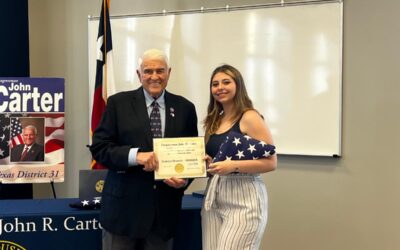
Lake Belton senior awarded CTE award from Congressman
By LYNETTE SOWELL The Belton Journal A senior at Lake Belton High School is the winner of the Career and Technical Education Award, given annually by Congressman John Carter, of District 31 of the United States House of Representatives. Dakota Branch, a senior at Lake...

BISD Penguin Project Presents Finding Nemo Jr. April 26-28th
By DAVID TUMA The Belton Journal Jennifer Ramirez updated the Belton Lions Club on the second annual theater production through The Penguin Project. This program uses special needs children and volunteers to produce a play. This year they will perform Finding...

Fast CAT trials for dogs coming to Belton
By ANNIE DOCKERY The Belton Journal Belton is one of the newest locations for American Kennel Club (AKC) Fast Coursing Ability Test (CAT) Trials. The Bearded Collie Club of America along with the Bearded Collie Club of Texas will be holding the family-friendly...

Belton ISD breaks ground on transitional campus for special needs students
By MIKE MYERS The Belton Journal Belton ISD held a groundbreaking ceremony earlier this month for the Belton Delta Program Facility, a shared collaborative effort aimed at enhancing the educational experience of students with disabilities. The facility, part of...

Pickup Your Belt Buckle Magazine Now!!
The Belton population has grown by 10% since the last census. So, we are now offering the Belt Buckle online! We want all of our new friends to know what the Belton area has to offer. Every year this magazine grows by 8 pages, and we are always looking for ways to...

Reserve your vendor space now at the Bell County Senior Expo
It's Beginning To Look A Lot Like Senior Expo time! We'll Rock Around the 14th Annual Bell County Senior Expo on Tuesday, September 24th, 2024 from 8:00-1 in the Exposition Building at the Cadence Bank Center (Bell County Expo Center). All I Want for Christmas is for...

Lake Belton librarian Petter adds published editor to accomplishment
By TONY ADAMS The Belton Journal Nearly five years ago, Jordan Petter hung up the coach’s whistle and stepped away from teaching blended English at Belton High School and transitioned to become Lake Belton High School’s Digital Information Specialist and...

Tuesday’s strong storms dump rain locally, cause flooding
By MIKE MYERS The Belton Journal According to a press release issued by Paul Romer, Director of Communications, at around 10 a.m. Tuesday morning, the City of Belton was hit with some straight line winds that hit Leon Heights/Main Street area. Two power poles were...
Parents as Partners: Technology, Social Media and its Impact on Youth
By MIKE MYERS The Belton Journal The informational session on the social and emotional impacts of technology use, misuse, and potential legal implications was provided by speakers from the Texas Step Up Organization. Guest speakers Tony Jimenez, BA, and Deyanira...

Morgan’s Point city council unveils strategic plan
By DAVID TUMA The Belton Journal The Morgan’s Point Resort City Council unveiled the 2024 Strategic Work Plan for the year at the council meeting in March. The mission statement for the City of Morgan’s Point Resort is: “To provide charming lakeside living that...

BISD facing major budget deficit for upcoming year
Staff reports At their March 25 meeting, the Belton ISD Board of Trustees adopted assumptions to guide the district’s budget planning for the 2024-25 fiscal year. The 88th Legislature did not increase the basic allotment, which is the amount per student allocated to...

Trustees hire Dr. Malinda Golden as Superintendent of Belton ISD
Special to the Journal The Board of Trustees approved hiring Dr. Malinda Golden as the Belton ISD superintendent of schools. Golden has been serving as acting superintendent since January 10, 2024, following the resignation of Dr. Matt Smith. She was named Lone...

Arusha’s Coffee adds bean roaster to facility
By DAVID TUMA The Belton Journal Arusha’s Coffee was created in 2012 when Hatem Chouchane and Ernst Jacques purchased Heidenheimer Coffee on East Street in Downtown Belton. Over the years Arusha’s has added a variety of items to the menu. They now have more than 100...

Lakewood Elementary assistant principal receives grant
Special to the Journal Lakewood Elementary School Assistant Principal Ashlie Thomas was surprised by the Education Service Center Region 12 Technology Foundation with a $12,940 grant on Tuesday morning. Thomas was one of nine Region 12 educators who are receiving over...
Come Write For Us!


DON RINGLER TOYOTA

OUR HOSPICE HOUSE

Click Below For 3 MONTHS FREE!

CAROTHERS EXECUTIVE HOMES

Belt Buckle Newcomer’s Guide

ALTON THIELE

DON RINGLER CHEVROLET

STANDARDS HOME HEALTH

DOUBLE T CONSTRUCTION

BELTONIAN